


Artificial intelligence is shifting from a back-office experiment to a core driver of business strategy. For business leaders, AI is not just about automation. It is about improving decision-making and building a competitive advantage.
At its foundation, AI enables data-driven decision-making. AI tools for business can analyse large volumes of business data, surface patterns and generate predictive insights. This allows organisations to move from instinct-led strategy to evidence-led planning.
AI also strengthens due diligence, productivity, and capital allocation. When businesses use AI to automate analysis, forecast performance and model scenarios, leadership teams gain clearer visibility over risk and opportunity. That clarity supports faster, more confident strategic decisions.
For mid-market companies, the impact of AI extends beyond efficiency. It influences how businesses grow, compete, and position themselves for investment or acquisition. In this way, AI adoption becomes a strategic lever rather than just a technology upgrade.
Understanding ChatGPT and generative AI
Artificial intelligence includes many different AI models. Two of the most widely recognised today are ChatGPT and generative AI tools.
ChatGPT
ChatGPT is a language model that utilises GPT architecture. This allows it to process and comprehend natural language in a human-like manner. ChatGPT can generate coherent, contextually relevant responses and simulate human-like conversations. This is achieved through harnessing vast amounts of data and training on diverse language patterns.
This makes ChatGPT a powerful tool for various business applications, including;
- Chatbots
- Customer service assistants
- Automating repetitive tasks or functions
Generative AI
Generative AI refers to AI systems that create new content, insights or outputs based on existing data. This includes text, images, code and analytical summaries. Generative AI tools are trained on large datasets and use advanced AI algorithms to identify patterns and produce relevant outputs.
In a business context, generative AI can support marketing materials, reporting, forecasting, and customer engagement. When properly governed, it becomes a scalable intelligence tool that enhances processes and decision-making across your business.
How businesses are using AI tools today
Recent data shows that AI tools for business are primarily being adopted to improve productivity and operational efficiency. This reflects broader economic pressures, particularly in developed markets where productivity growth has slowed.
Productivity and economic context
Between 1995 and 2015, Australia recorded consistent real GDP growth of 2% to 5% per year, supported by productivity growth of 2% to 3% annually. Approaching 2020, productivity began to flatten, and post-COVID, it declined.
With population growth now exceeding productivity growth, businesses are under increasing pressure to improve output per worker. AI adoption is emerging as a response to this structural challenge.
Unlike previous innovations, AI can autonomously perform cognitive tasks, analyse massive datasets in real time, and continually improve through machine learning. From automating customer service to optimising supply chains and enhancing medical diagnostics, AI is unlocking new efficiencies across both blue- and white-collar domains.
It promises not only incremental improvement, but exponential acceleration in output per worker, precisely what modern economies now require.
Where businesses are applying AI tools
Based on current implementation trends, businesses are using AI tools for business in the following areas:
- Automating repetitive internal tasks and administration
- Analysing large datasets to improve forecasting accuracy
- Enhancing customer service through AI chatbots and AI assistants
- Supporting marketing analytics and targeted campaigns
- Improving operational efficiency across supply chains
In terms of its impact on M&A activity, AI has the potential to significantly increase transaction volume. Historically, periods of significant change have triggered increased M&A activity, as companies make strategic investments to protect their core business and drive growth.
Performance impact
AI systems can process and interpret business data at speeds beyond human capacity. This enables faster reporting cycles, improved scenario modelling and more informed capital allocation decisions.
In practice, AI tools help businesses improve productivity, reduce processing time and support more consistent decision-making across teams. As adoption matures, AI capabilities are expected to influence not only operations but also valuation and transaction readiness.
[download_industry_guides][/download_industry_guides]
Benefits of AI adoption for businesses
AI adoption can materially improve how a business operates and grows. When implemented strategically, AI tools for business deliver measurable gains in productivity, scalability and innovation.
Benefits
Improved productivity
AI automation for business reduces manual tasks, accelerates reporting and supports faster decision-making. Teams can focus on higher-value strategic work rather than repetitive processes.
Greater scalability
AI platforms can handle increasing volumes of data and transactions without proportional increases in headcount. This supports margin expansion and sustainable growth.
Enhanced innovation
Generative AI tools help businesses brainstorm ideas, test new concepts and develop marketing materials more efficiently. AI capabilities allow companies to experiment faster and refine offerings using real-time insights.
Stronger data-driven strategy
AI algorithms surface patterns within business data that may otherwise go unnoticed. This strengthens forecasting, capital allocation and long-term business strategy.
Competitive advantage
Businesses that leverage AI effectively can respond faster to market shifts, optimise pricing and improve customer engagement across their operations.
Considerations
Integration complexity
Implementing AI solutions across business operations requires clear governance and structured rollout.
Over-reliance risk
AI tools should support leadership judgment, not replace it. Human oversight remains critical.
Cost and capability gaps
Training, maintenance and internal expertise are required to sustain AI productivity gains over time, increasing your overall business valuation.
Key challenges businesses face when adopting AI
AI adoption presents significant opportunities but also introduces real risks. Artificial intelligence challenges and opportunities must be assessed in parallel, particularly when AI tools for business are embedded into core operations. Without strategic alignment and proper oversight, AI adoption can increase exposure rather than strengthen competitive advantage.
Challenge 1: Integration complexity
Given the complex nature of AI, incorporating this technology into an existing business ecosystem is no easy task. Business owners should be prepared to invest significant time and resources in understanding the underlying technology, identifying suitable use cases within their organisation, and appointing professionals to manage the integration process.
Key integration challenges include:
- Aligning new AI platforms with existing systems integration frameworks
- Upgrading IT infrastructure to support AI processing demands
- Ensuring data quality and interoperability across platforms
- Managing implementation timelines and internal change management
Without a structured rollout plan, AI integration can take longer and consume more resources than anticipated, limiting its intended productivity benefits.
Challenge 2: Data privacy and security concerns
Training AI systems like ChatGPT requires access to vast amounts of data, most of which includes private business and customer information. AI data usage introduces heightened privacy and cybersecurity risk, particularly where sensitive commercial or customer information is involved. As AI tools for business rely on large datasets, governance standards must evolve alongside adoption.
Key AI data privacy concerns include:
- Protecting confidential business data from unauthorised access
- Ensuring cybersecurity controls keep pace with new AI platforms
- Preventing misuse of data within generative AI systems
- Establishing clear AI governance frameworks and accountability
When implementing AI systems, organisations should prioritise data privacy and security best practices to protect privileged information and maintain customer trust.
Challenge 3: Quality control and reliability
Although generative AI models are highly advanced, they may occasionally produce inaccurate or out-of-context responses. Business owners should establish robust quality control mechanisms to ensure that AI-generated content aligns with their brand image, values and target market.
Key AI quality control considerations include:
- Verifying AI-generated insights before strategic decisions are made
- Implementing human-in-the-loop review processes for customer-facing content
- Monitoring AI models for bias, inconsistency or outdated information
- Establishing accountability for errors within automated workflows
Strong quality assurance frameworks ensure AI supports decision-making rather than undermines reliability.
Challenge 4: Training and maintenance costs
Properly training and maintaining AI systems can be costly, especially for smaller businesses with limited budgets. Businesses should weigh the potential benefits of AI adoption against the ongoing development costs required to maintain such systems.
Key cost considerations include:
- Initial staff training to use AI tools effectively and responsibly
- Continuous AI maintenance, updates and model refinement
- Infrastructure and licensing costs associated with AI platforms
- Evaluating total cost of ownership against measurable productivity gains
Without disciplined cost management, AI training and maintenance expenses can erode the expected return on investment.
AI as the new engine of economic growth
![Infographic comparing 1995–2015 growth rates with post-2020 productivity.]](https://cdn.prod.website-files.com/5b6bc984b3323e4065ff1932/6a41f30af90b0844ddad1159_02_Economic%20Productivity%20Data%20Visualisation%20(1).jpg)
Recent economic data by the Reserve Bank of Australia highlights why AI adoption is increasingly linked to productivity gains and long-term economic growth.
Productivity and GDP trends (Australia)
- 1995–2015: Real GDP growth averaged between 2% and 5% per year
- Population growth: 1%–2% annually during the same period
- Productivity growth: 2%–3% annually
- Post-2020: Productivity growth flattened and, in some periods, declined
With population growth now exceeding productivity growth, economic expansion is increasingly dependent on efficiency gains.
AI and productivity gains
Artificial intelligence offers the potential to reverse this slowdown by:
- Automating cognitive and administrative tasks
- Enhancing data-driven forecasting and resource allocation
- Improving output per worker across knowledge-based roles
In this context, AI economic growth is not simply technological advancement. It represents a structural response to slowing productivity across developed markets. For businesses, AI adoption becomes directly linked to long-term competitiveness and market expansion.
How AI is reshaping M&A strategy
.jpg)
AI capabilities are increasingly influencing mergers and acquisitions strategies. As businesses adopt AI tools for business across operations, AI for business strategy becomes directly linked to corporate strategy and long-term growth planning.
Periods of major technological change have historically triggered increased deal activity. Companies pursue acquisitions to secure capability, protect market share and accelerate innovation. Artificial intelligence is no different. Businesses are acquiring AI-enabled competitors, investing in new capabilities and repositioning portfolios to remain competitive.
AI is also changing how deals are evaluated. Advanced analytics tools improve target screening, financial modelling and scenario testing. Leadership teams can assess acquisition opportunities with greater precision, supporting more disciplined capital allocation.
In this way, AI for M&A strategy operates on two levels. It shapes why companies pursue transactions and how those transactions are executed. For mid-market organisations, AI adoption is becoming both a competitive necessity and a strategic catalyst for deal-making.
Choosing the right AI tools for your business
Businesses evaluating AI tools for small businesses or mid-market organisations should assess each solution against clear commercial criteria.
Use this checklist when comparing AI solutions for business:
- Define the objective: Identify the specific business problem the AI tool is solving. Avoid adopting new tools without a measurable outcome.
- Assess strategic fit: Ensure the AI platform aligns with your corporate strategy, growth plans and operational priorities.
- Test integration capability: Confirm compatibility with existing systems, data environments and IT infrastructure.
- Evaluate scalability: Determine whether the AI solution can support future growth without high additional cost.
- Review security controls: Examine data privacy standards, cybersecurity safeguards and governance frameworks.
- Calculate total cost of ownership: Consider licensing, implementation, training and ongoing maintenance before committing.
The most effective AI tools for business are those that strengthen performance, support long-term strategy and deliver measurable productivity gains.
Preparing your business for an AI-enabled future
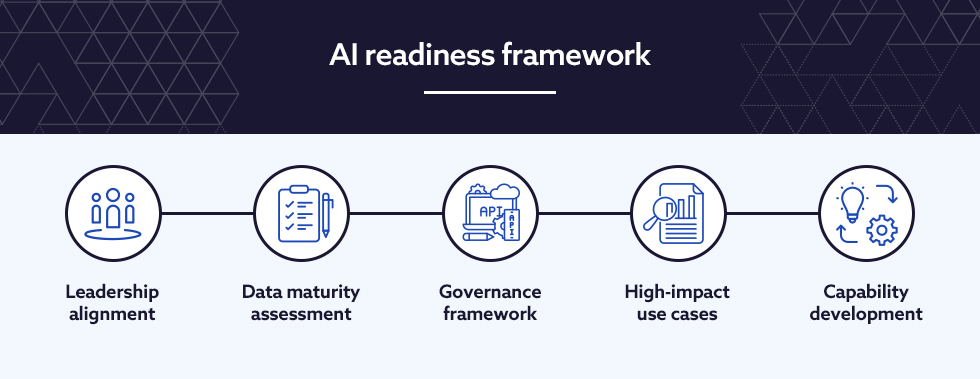
AI readiness is not just about selecting the right technology. It depends on leadership alignment, data maturity and governance discipline across your business.
Step 1: Establish leadership ownership
AI adoption should be led at an executive level. Define how AI solutions for business align with corporate strategy, growth plans and M&A objectives.
Step 2: Assess data maturity
Evaluate the quality, accessibility and structure of your business data. AI systems rely on clean, reliable datasets to generate accurate insights.
Step 3: Define governance frameworks
Set clear policies for AI usage, data privacy and human oversight. Strong governance reduces risk and improves accountability.
Step 4: Prioritise high-impact use cases
Identify where AI can improve productivity or enhance decision-making. Focus on initiatives with measurable commercial outcomes.
Step 5: Build internal capability
Invest in training and digital transformation initiatives that support long-term AI adoption and business readiness.
Preparing early positions your organisation to leverage AI strategically, strengthen competitiveness and respond confidently to future market shifts.
How Nash Advisory helps businesses navigate AI-driven growth and M&A
Artificial intelligence is changing how businesses compete, grow and transact. As AI capabilities reshape productivity, valuation drivers and corporate strategy, business owners and investors need more than technical insight. They need strategic clarity.
Nash Advisory works with mid-market companies to assess how AI adoption influences enterprise value, acquisition strategy and exit readiness. Our directors provide hands-on, senior-led advice grounded in commercial experience and data-driven analysis. Whether you are pursuing growth through mergers and acquisitions, preparing for a future sale, or evaluating the strategic impact of AI on your industry, we help you make confident, well-informed decisions.
In an AI-enabled economy, positioning matters. The right strategy can strengthen competitive advantage and maximise transaction outcomes. If you are considering growth, investment or an eventual exit, speak to us about our business advisory services to understand how AI for business strategy may shape your next move.
[internal_links_sell_business_advisors][/internal_links_sell_business_advisors]


