


.jpg)

Preparing to sell your business takes far more planning than selling a car or property. A successful business sale requires careful preparation across financial, operational and strategic areas to ensure buyers see the full value of your business.
In a typical sales cycle, we find that in 100 potential buyers:
- 20 per cent are interested to learn more
- 5-10 per cent will make a bid
- Of those that bid, only 3-5 per cent are serious enough to go ahead with a purchase.
Most business owners underestimate how long the sales process takes. In reality, finding the right buyer, completing due diligence and negotiating the sale agreement can take many months. Preparing early helps maximise the value of your business and ensures the exit process runs smoothly.
As a guide, we often recommend starting preparation 12 to 18 months before you plan to sell your business. This gives you time to improve performance, organise financial records and position the business in a way that appeals to potential buyers.
Lock in the right advisors early
Preparing to sell your business is rarely a process you should manage alone. Engaging the right advisors early helps ensure the sale process is structured correctly and reduces the risk of delays during due diligence.
Most successful business sales involve a coordinated team of advisors who guide the owner through legal, financial, and strategic decisions. Having the right expertise in place early can help maximise the value of your business and improve outcomes when negotiating the sale.
Your business exit plan should include all key working advisors in the process:
- Corporate advisor – Helps prepare your business for sale, identify potential buyers, and manage the sale process from marketing through to negotiation.
- Accountant – Provides financial and tax planning advice, including how the sale of your business may affect your tax position and personal financial goals.
- M&A lawyer – Ensures the sale agreement, legal structure, and contractual obligations are properly managed and protects your interests throughout the transaction.
Bringing these advisors together early enables you to strategically prepare your business and ensure the sale process runs smoothly.
Get your financials and data in order
Not having clean financials and normalised accounts ready to go can cause significant delays when preparing the business for ultimate exit.
Any business exit plan should have a clear goal of having clean and normalised accounts. Most business owners do not think much about this aspect, because most businesses do not have prospective buyers reviewing their books.
During the due diligence process, buyers typically request detailed financial and operational information to verify the value of your business. This includes historical financial statements, tax records, customer concentration data and operational metrics.
To prepare your business for sale, ensure the following information is organised and accessible:
- Financial statements – Profit and loss statements, balance sheets and cash flow reports covering several years.
- Tax records – Documentation supporting tax filings and any outstanding tax obligations.
- Operational data – Customer contracts, supplier agreements and sales performance metrics.
- Key performance indicators – Data demonstrating the profitability and growth of your business.
Clear and accurate financial records give potential buyers confidence in the business and help ensure the due diligence process runs smoothly.
[toolkit][/toolkit]
Build a strong, stable management team

A strong management team is one of the most important factors buyers consider when evaluating a business for sale. If the business relies heavily on the owner to run daily operations, it increases the risk for a potential buyer.
Many privately owned businesses are heavily dependent on the founder or owner. Strengthening the leadership structure before entering the sale process can reduce this dependency and make the business more attractive to investors.
Before preparing to sell your business, consider whether your organisation has:
- A capable CEO or general manager who can run the business independently
- A strong finance function, such as a CFO or financial controller
- Experienced operational leaders responsible for key business functions
In all likelihood, building an advisory team around you in the eyes of any prospective buyer will be highly regarded and increase the chances of a successful outcome.
One of the top reasons businesses don’t sell, or even get past the initial assessment from a buyer, is that the owner is full-time in the business and doesn't have a team around them to manage the business and execute a growth plan.
Focus on sustainable growth, not short-term fixes
Your business performance should continue to focus on growth, even as you plan to sell. A business that is doing well is hugely appealing to buyers and investors.
A sudden drop in revenue or profitability during the sale process can raise concerns for a potential buyer. Maintaining steady growth shows that the business is healthy and capable of performing well under a new owner.
Here are some benefits of focusing on sustainable growth before a business sale:
- Higher buyer confidence – Consistent performance reassures potential buyers that the business can continue to generate reliable sales.
- Improved valuation outcomes – Strong financial performance helps maximise the value of your business during negotiations.
- Stronger exit strategy planning – Demonstrating growth and stability positions the business as a lower-risk investment.
Rather than focusing on short-term gains, business owners should prioritise strategies that strengthen long-term profitability and operational stability.
Improve your brand and market positioning
Your brand and market positioning play an important role when preparing to sell your business. Buyers are not only evaluating financial performance. They are also assessing the strength of your reputation, customer relationships, and market presence.
A well-established brand signals stability and long-term potential. Businesses that clearly communicate their value proposition and maintain a visible market presence are often more attractive to potential buyers. Strong brand positioning helps buyers understand what differentiates the business and why customers continue to choose its products or services.
Improving your brand before the sales process may involve strengthening your online presence, refining your brand messaging, and expanding marketing activities that support future sales growth. These efforts can reinforce customer trust and demonstrate that the business has a sustainable platform for continued success under a new owner.
Using digital marketing to increase sales value
A well-developed digital marketing strategy can significantly improve the value of your business before entering the sales process. Buyers closely examine how a business attracts customers and generates sales, particularly whether its marketing systems are scalable and transferable to a new owner.
A structured approach to digital marketing can strengthen business visibility and demonstrate consistent market demand. Business owners preparing for a sale should first evaluate their current online presence, including website performance, search visibility and customer engagement channels.
The next step is to establish reliable customer acquisition channels. Search engine optimisation, social media marketing and targeted digital advertising can help broaden audience reach and generate consistent leads. These activities also demonstrate that the business has a functioning marketing system rather than relying solely on personal relationships or word-of-mouth referrals.
Finally, documenting and systemising these marketing processes makes the business easier for a buyer to take over. A clear digital marketing strategy signals that customer acquisition can continue under new ownership, thereby improving buyer confidence and increasing the perceived value of the business.
Retain key people and manage business continuity
Management and staff are integral to an ultimate business exit plan. While most buyers want to only meet the top 2 or 3 executives, knowing that the key people will be retained will help create long-lasting value.
Key employees often hold operational knowledge, customer relationships, and leadership responsibilities that are essential to the business's stability. If these individuals leave during the sale process, it can increase risk for a potential buyer and affect the perceived value of the business.
To protect business continuity during a sale:
- Ensure key employees have current employment contracts and clear responsibilities
- Strengthen leadership roles so the business can operate without direct owner involvement
- Develop a transition plan that outlines how operations will continue under a new owner
Taking these precautions helps reassure buyers that the business will remain stable and able to perform after the sale.
Risks of selling without a marketing strategy
Your business valuation will be impacted in the sale of your business if there is no clear digital marketing strategy in place. Buyers want to understand how the business generates new customers and maintains consistent sales over time. If marketing systems are unclear or inconsistent, the business may appear riskier to potential buyers.
To avoid this issue, business owners should review and strengthen their marketing approach before entering the sales process.
Step 1: Assess how customers currently find your business
Start by reviewing the main sources of new customers. If sales rely heavily on personal networks, referrals, or the owner’s relationships, buyers may question whether those sales will continue after the transition.
Step 2: Identify gaps in marketing systems
Look for areas where marketing activity is inconsistent or undocumented. Businesses with weak online visibility, limited marketing channels or unclear customer acquisition strategies may struggle to demonstrate long-term growth potential.
Step 3: Establish repeatable marketing channels
Implement structured marketing activities such as search engine optimisation, paid advertising, or email marketing. These systems help demonstrate that the business can consistently attract customers without relying on the owner.
Strengthening marketing systems before the sale process helps improve buyer confidence and supports a stronger valuation outcome.
Define a clear and realistic exit strategy
Another area where business owners can ensure they have a strong business exit plan strategy is by creating and articulating a medium to long-term business strategy document.
This area usually receives less day-to-day attention from most business owners. In our experience, having a document prepared that encapsulates the business strategy will be well received by any potential buyer looking to invest in or acquire the business.
An effective exit strategy outlines how the ownership transition will occur and the outcomes the owner hopes to achieve. This may include deciding whether to sell the business to an external buyer, merge with another company, or transition through succession planning.
Taking the time to define a realistic company exit plan helps ensure the business is positioned correctly before entering the market. Buyers are more confident when they can see a structured strategy behind the sale and a clear plan for how the business will continue operating after the transition.
Start early to maximise value and optionality
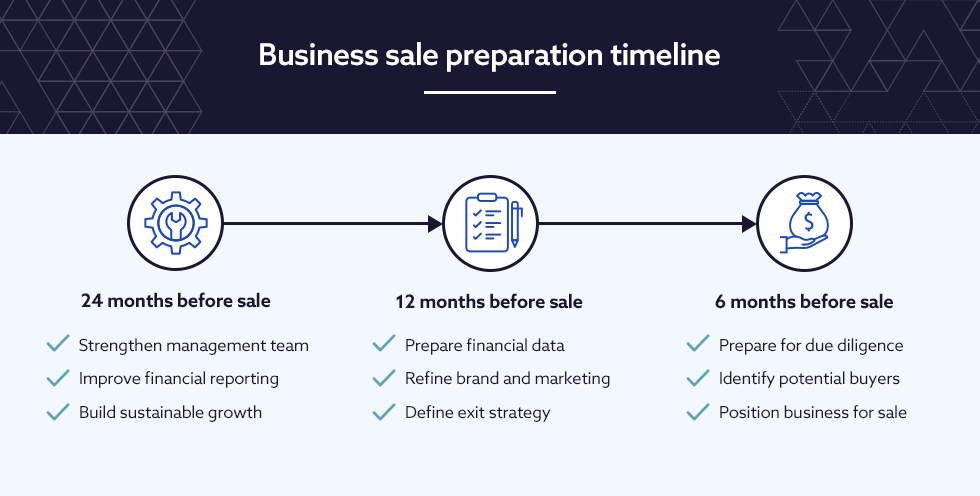
When planning to sell a business, timing can significantly impact the final outcome. Business owners who begin exit planning early typically have more flexibility to improve performance, strengthen operations and position the company effectively for buyers.
Starting the preparation process well before entering the market allows time to address issues that could affect valuation or delay the transaction. It also provides the opportunity to refine strategy, strengthen management capability and ensure financial records are ready for buyer review.
Early exit planning ultimately gives business owners greater optionality. With more time to prepare, owners can consider different transaction pathways, attract a wider range of buyers and maximise the value achieved from the sale.
Talk to Nash Advisory about our services and find out how we can help you achieve a successful business sale.
[internal_links_sell_my_business][/internal_links_sell_my_business]


