



Why buyers use debt when acquiring a business
Buyers often use debt to increase acquisition capacity while preserving their own equity. Buying a business with debt allows a business owner or investor to control a larger company without funding the entire purchase price upfront.
When financing a business acquisition, rather than deploying all available capital, the buyer borrows part of the price from a lender. This approach enables the buyer to leverage debt strategically as part of a broader acquisition strategy. It can allow access to stronger or more profitable businesses for sale that may otherwise be out of reach.
When the acquired business generates stable revenue and profit, its cash flow may help service interest payments and scheduled loan repayments. In these circumstances, business owners can use debt to expand their asset base while maintaining flexibility.
Using debt financing also preserves equity for other growth initiatives, operational improvements or diversification. This can be particularly valuable for SMEs and mid-market companies pursuing long-term expansion.
However, buyers must assess repayment capacity carefully. Thorough due diligence, realistic financial projections and clear repayment terms are essential. When done appropriately, debt can strengthen purchasing power without undermining financial stability.
Understanding what it means to buy a business with debt
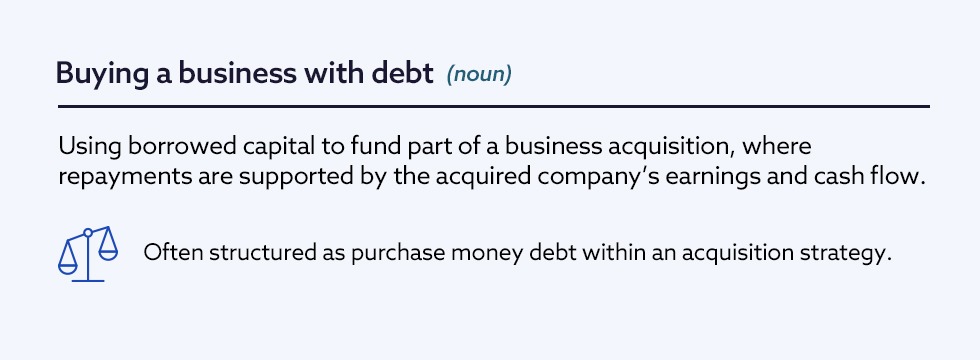
Buying a business with debt means using borrowed capital to fund part of the transaction rather than paying the full price upfront. In a typical business acquisition, the buyer secures financing from a funding provider, often in the form of purchase-money debt. The acquired business then generates earnings to help service repayments under agreed terms.
Depending on the format, debt may be secured against business assets, supported by corporate guarantees, or partially funded by a vendor. Buyers usually contribute equity alongside borrowed funds to ensure a balanced and sustainable capital structure.
This approach introduces both opportunity and liability. The business owes scheduled repayments and interest, which become ongoing expenses that must be supported by cash flow and profitability. Creditors assess creditworthiness, projected returns and financial management capability before agreeing to lend. In some cases, interest payments may be tax-deductible and reduce overall tax liability, subject to professional advice. When properly structured and supported by thorough due diligence, debt can be a strategic and transparent part of a long-term acquisition strategy.
How debt can increase purchasing power
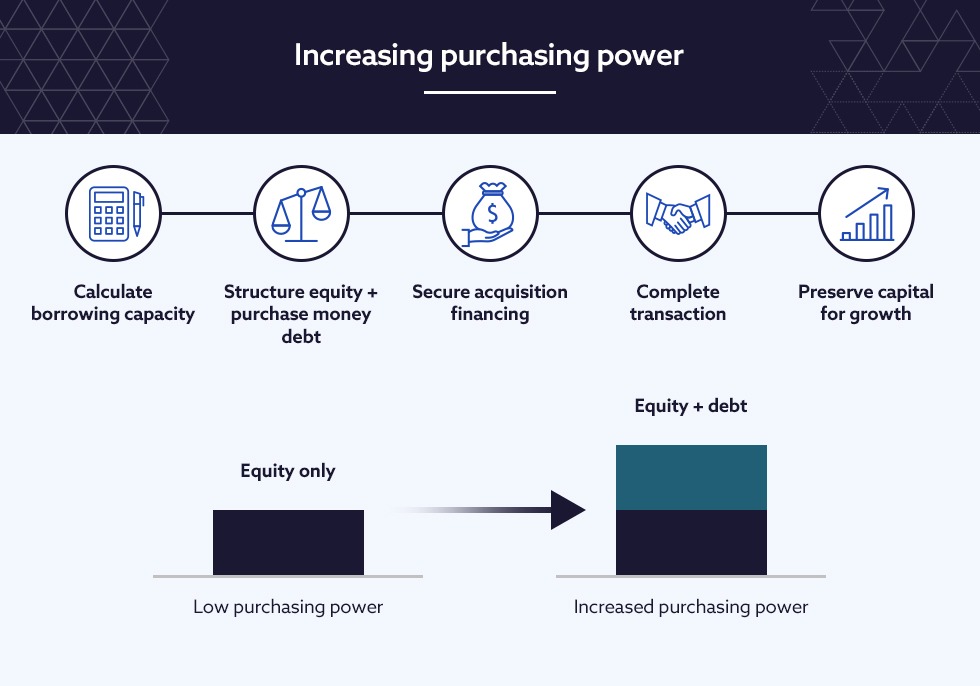
Debt financing increases purchasing power by allowing buyers to combine equity with borrowed capital. Instead of relying solely on available cash, buyer leverage enables larger or more strategic agreements.
When using purchase money debt, the buyer contributes part of the purchase price and secures acquisition financing for the balance. This structure increases the total funds available for the deal. As a result, buyer purchases can extend to stronger businesses, larger firms or assets that may otherwise be out of reach.
The process begins with calculating borrowing capacity. There will be an assessment of projected returns, cash flow strength and overall credit profile before agreeing to lend. Buyers must carefully calculate repayment capacity to ensure the framework remains sustainable.
Next comes structuring the right financing mix. This may include senior debt, subordinated debt or vendor finance as part of the commercial consideration. Flexible repayment terms can improve cash flow management and provide clarity during the transition period.
By spreading capital across both equity and debt, buyers can optimise investment capacity while preserving liquidity. This flexibility allows them to invest in operational improvements, partnerships or growth initiatives after close.
When managed carefully, acquisition financing does more than complete a deal. It strengthens purchasing power while supporting long-term success and disciplined financial decisions.
Using debt to enhance returns on equity
In a debt-funded acquisition, buyers use leverage to amplify returns on equity. Rather than funding the full acquisition price with capital, the buyer invests a portion of equity and borrows the balance. If the acquired business generates consistent revenue and strong cash flow, those profits are attributed to a smaller equity contribution. This format can materially increase returns on equity compared to an all-cash agreement.
This effect becomes more pronounced when valuation is based on earnings multiples, such as an EBITDA multiple. If a buyer acquires a company at a disciplined multiple and improves operational performance, equity value can grow faster than the original investment. However, leverage must remain sustainable and aligned with realistic projections. Prudent debt levels and disciplined financial management are essential to ensure enhanced returns on equity do not come at the expense of long-term stability.
Debt as a tool for asset diversification
Debt can enable asset diversification without requiring full equity deployment. When buying a debt business as part of a broader portfolio strategy, investors can allocate capital across multiple opportunities rather than concentrating funds in a single transaction. Instead of assuming all the risk in a single new business, buyers can utilise funding to preserve equity for additional investments.
This approach supports asset diversification across sectors, geographies or revenue streams. For example, a buyer may acquire a small business in one industry while retaining the capacity to invest elsewhere. Used carefully, debt allows investors to build a more balanced portfolio without overextending capital. However, each transaction must be assessed on its own merits to ensure leverage remains sustainable and aligned with long-term objectives.
Preserving cash flow and balance sheet flexibility
Debt funding can preserve cash flow and maintain balance sheet flexibility during a business acquisition. Rather than deploying all available capital at close, buyers use acquisition finance to spread payments over time. This approach supports disciplined cash flow management and ensures working capital remains available for operational needs.
Maintaining liquidity can be critical after completion, particularly when integration costs or growth initiatives are present. By structuring favourable repayment terms, buyers can align debt servicing with projected earnings. This preserves balance sheet flexibility and reduces immediate financial strain. When managed prudently, acquisition finance allows businesses to pursue expansion while protecting stability.
Potential tax advantages of debt-funded acquisitions
Debt interest may create tax-deductible benefits, depending on the acquisition tax structure and specific circumstances. While tax outcomes vary, there can be legitimate tax advantages of debt when properly arranged and advised.
Potential benefits:
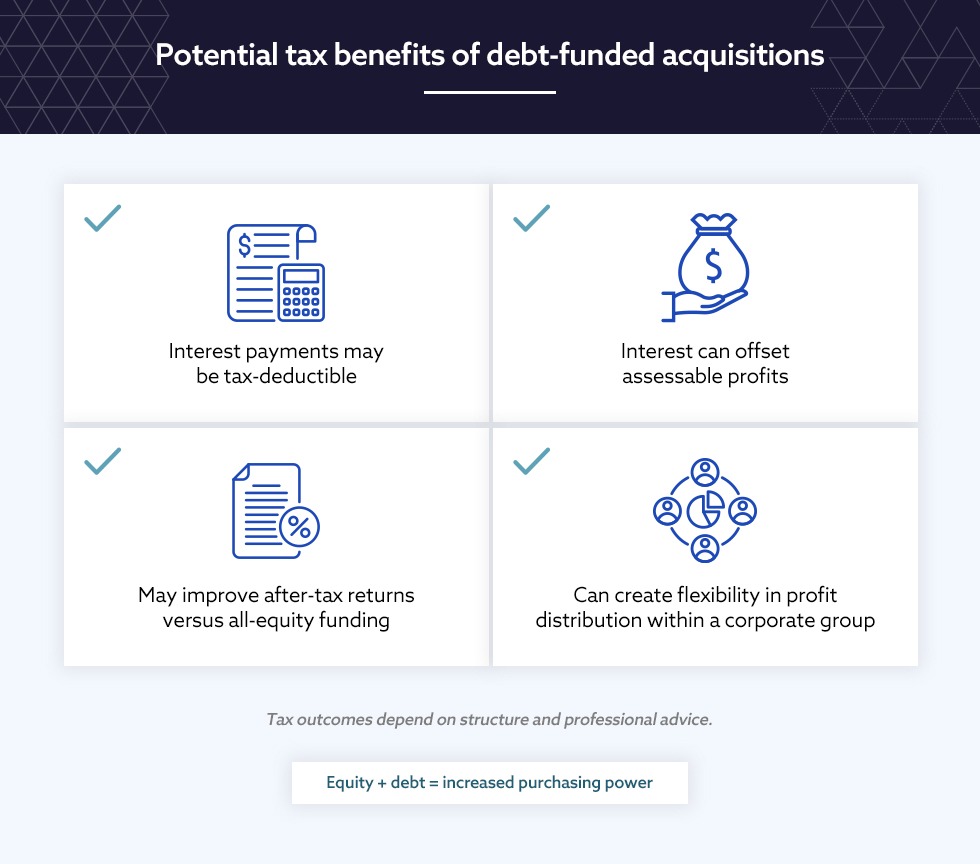
- Interest payments on acquisition debt may be tax-deductible, thereby reducing taxable income.
- Deductible interest can offset assessable profits, potentially lowering overall tax liability.
- A well-designed acquisition tax model may improve after-tax returns compared to an all-equity transaction.
- Debt funding can sometimes create flexibility in how profits are distributed within a corporate group.
Important considerations:
- Tax outcomes depend on how the transaction is structured and whether the debt relates directly to income production.
- Changes in tax law or ATO guidance may affect deductibility.
- Excessive debt may attract scrutiny, particularly where structures appear aggressive.
- Buyers should seek independent tax advice to ensure the framework is compliant and commercially sound.
Used appropriately, debt can offer tax advantages as part of a broader acquisition strategy. However, taxes should support commercial objectives.
A practical example of buying a business using debt
A debt-backed acquisition demonstrates how leverage affects deal outcomes in practice.
Using the example below, where a buyer has made an offer of $50m for a business that is making $10M EBITDA p.a. (assuming a 5x EBITDA multiple) through debt, the buyer can reduce the initial cash outlay from $50 million to $35 million. The purchaser's return on equity in year 1 is then enhanced from 20% using no leverage, increasing to 26% utilising leverage, as the cost of debt is lower than the expected return on equity.
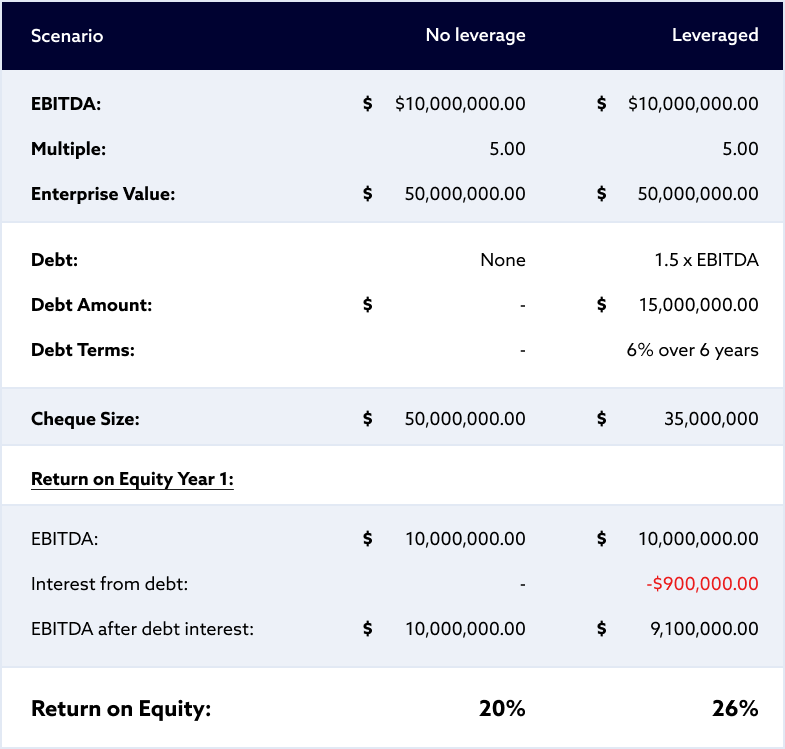
Now consider buying a business with existing debt. In this case, assumed liabilities must be carefully assessed during due diligence. The price may be adjusted to reflect what the business owes, and cash flow modelling must account for ongoing repayment obligations. This example shows that leverage can amplify returns, but it can also magnify risk if revenues fall short. The outcome depends on disciplined structuring, realistic assumptions and sustainable debt levels.
Key risks buyers should consider when using debt
Excessive leverage increases financial and operational risk in any business acquisition. While debt can improve returns, debt servicing obligations remain fixed regardless of performance. If revenue declines or margins tighten, cash flow pressure can escalate quickly. This creates both immediate financial risk and broader acquisition risk.
Overestimating earnings is one of the most common pitfalls. If projected profitability does not materialise, repayment commitments may restrict investment and strategic flexibility. Lender covenants can further limit operational decisions or additional borrowing. Structuring and conservative modelling are essential to prevent leverage from undermining long-term stability.
How Nash Advisory helps buyers structure debt-backed acquisitions
Nash Advisory structures debt-funded acquisition strategies that balance opportunity with discipline. As part of its acquisition advisory services, Nash Advisory works directly with buyers to assess borrowing capacity, model debt servicing scenarios, and align funding with commercial objectives. The focus is not simply on securing finance, but on structuring deals that are sustainable and strategically sound. This ensures leverage supports long-term value rather than introducing unnecessary financial risk.
Whether buying or selling a business, capital structure plays a critical role in deal outcomes. Nash Advisory provides clarity across negotiations, lender engagement and transaction structuring, ensuring buyers understand both risk and return. For investors and business owners considering buying and selling debt-backed assets, disciplined advice can materially influence valuation and exit flexibility. As a seller, start with early strategic guidance to determine whether the deal merely closes or truly delivers value.
[internal_links_sell_my_business][/internal_links_sell_my_business]
Table of contents


